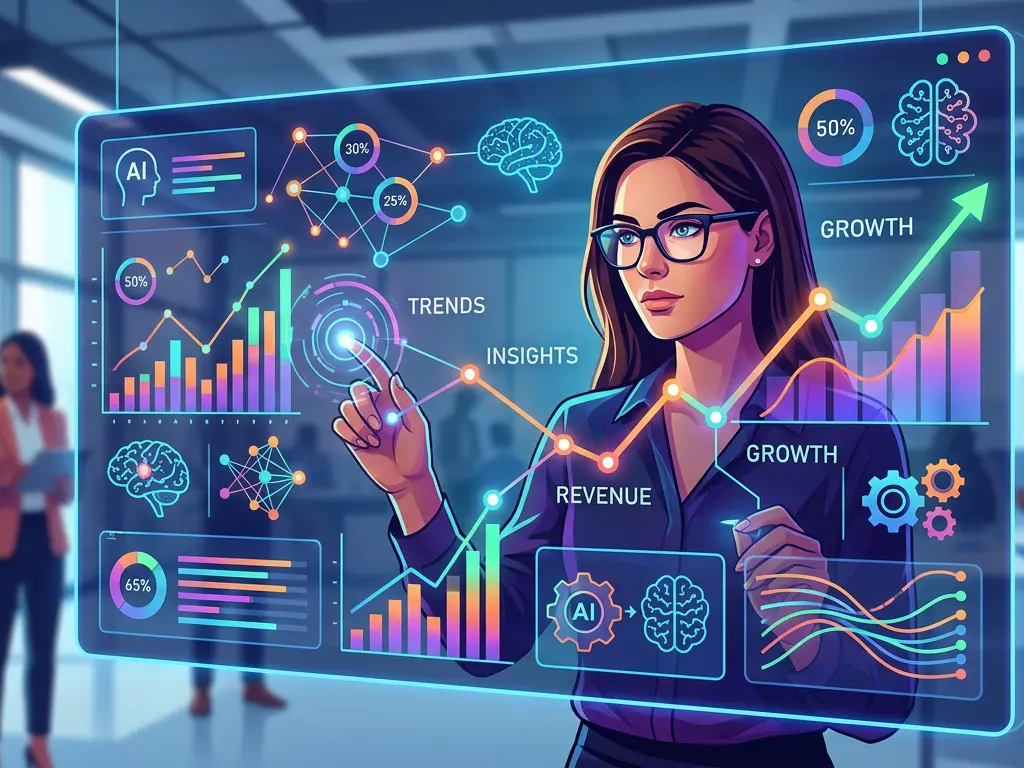
Best AI Analytics Tools for Data-Driven Decisions
Explore AI-powered analytics tools that help businesses make better data-driven decisions and gain actionable insights.

The Ultimate Guide to the Best AI Analytics Tools for Data-Driven Decisions
Introduction: Why AI Analytics is the New Competitive Imperative
In today's hyper-competitive business landscape, intuition and gut feeling are no longer enough. Organizations drowning in data but starving for insights are turning to a powerful ally: Artificial Intelligence. AI analytics tools are revolutionizing how businesses process information, predict trends, and make decisions. According to a recent McKinsey report, companies that leverage customer analytics extensively are more likely to outperform competitors in terms of profit—by a staggering 93%.
But with over 100 AI analytics platforms on the market, how do you choose the right one? This comprehensive guide cuts through the noise. We'll explore the top AI analytics tools that transform raw data into actionable intelligence, complete with features, pricing, real-world applications, and expert recommendations to help you build a truly data-driven organization.
Understanding AI Analytics: Beyond Traditional Business Intelligence
Before diving into specific tools, it's crucial to understand what sets AI analytics apart from traditional Business Intelligence (BI). Traditional BI answers "What happened?" through descriptive analytics and dashboards. AI analytics goes further, asking "Why did it happen?", "What will happen next?", and "What should we do about it?"
Key Capabilities of Modern AI Analytics Platforms:
- Predictive Analytics: Using historical data to forecast future outcomes
- Natural Language Processing (NLP): Allowing users to query data in plain English
- Automated Insights: Machine learning algorithms that surface hidden patterns
- Prescriptive Analytics: Recommending specific actions based on predictions
- Anomaly Detection: Automatically identifying outliers and unusual patterns
Top AI Analytics Tools for Every Business Need
1. Tableau + Tableau Pulse: The Visualization Powerhouse with AI Enhancement
Overview: Tableau has long dominated the data visualization space, and their AI integration through Tableau Pulse represents a significant evolution.
Key AI Features:
- Ask Data: Natural language querying that lets users ask questions in plain English
- Explain Data: Automated statistical analysis that explains why data points are outliers
- Tableau Pulse: Personalized, proactive insights delivered via metrics monitoring
- Einstein Copilot: AI assistant for data preparation and analysis
Pricing: Starts at $75/user/month (Tableau Creator), with additional costs for Pulse features.
Best For: Large enterprises with complex data visualization needs and teams requiring both deep analytics and intuitive exploration.
Real-World Example: A national retail chain uses Tableau's AI features to analyze point-of-sale data across 500+ locations. The "Explain Data" feature automatically identified that a 15% sales drop in the Midwest region correlated with unexpected weather patterns, enabling rapid promotional adjustments.
2. Microsoft Power BI: The Enterprise-Grade AI Analytics Suite
Overview: Deeply integrated with the Microsoft ecosystem, Power BI offers robust AI capabilities at competitive pricing.
Key AI Features:
- Quick Insights: Automated pattern detection across datasets
- AI Visuals: Built-in machine learning models for forecasting, clustering, and sentiment analysis
- Cognitive Services Integration: Pre-trained models for text analytics, image recognition, and more
- Decomposition Trees: Interactive visual analysis to break down metrics by different dimensions
Pricing: Power BI Pro starts at $10/user/month; Premium capacity starts at $4,995/month.
Best For: Organizations already invested in the Microsoft ecosystem and those needing strong collaboration features.
Use Case: A financial services firm uses Power BI's AI visuals to predict customer churn. By combining transaction history, customer service interactions, and demographic data, their model identifies at-risk customers with 87% accuracy, enabling targeted retention campaigns.
3. Qlik Sense: The Associative Analytics Engine
Overview: Qlik's unique associative engine differentiates it from competitors, allowing users to explore data connections freely without predefined queries.
Key AI Features:
- Insight Advisor: AI-powered recommendations for visualizations and analysis paths
- Cognitive Engine: Context-aware suggestions based on user behavior and data patterns
- Automated Creation: Natural language generation for insights explanation
- Predictive Analytics: Built-in time series forecasting and what-if analysis
Pricing: Business edition starts at $30/user/month; Enterprise pricing available upon request.
Best For: Organizations needing exploratory data analysis and those valuing associative data discovery over predefined dashboards.
4. ThoughtSpot: Search-Driven Analytics for the Modern Business
Overview: ThoughtSpot pioneered the search-driven analytics approach, making data exploration as simple as using a search engine.
Key AI Features:
- Natural Language Search: Google-like search interface for data queries
- SpotIQ: Automated insights engine that runs thousands of analyses in seconds
- AI Assistant: Conversational interface for follow-up questions and deeper dives
- Automated Modeling: AI-driven data modeling that reduces preparation time
Pricing: Starts at $95/user/month for the Pro version; enterprise pricing varies.
Best For: Companies with non-technical users who need quick answers without SQL or complex query building.
Practical Example: A healthcare provider uses ThoughtSpot to analyze patient outcomes. Administrators can ask "Which treatment protocols have the highest success rates for patients over 65 with diabetes?" and receive instant visual answers, leading to a 22% improvement in treatment efficacy.
5. Sisense: The AI-Powered Embedded Analytics Solution
Overview: Sisense excels at embedding analytics into existing applications and workflows with strong AI capabilities.
Key AI Features:
- AI Chatbots: Natural language interfaces that can be embedded into applications
- Machine Learning Models: Easy integration of custom ML models into analytics workflows
- Automated Insights: Proactive anomaly detection and trend identification
- Predictive Modeling: Drag-and-drop interface for building forecasts without coding
Pricing: Custom pricing based on deployment scale and requirements.
Best For: Software companies looking to embed analytics into their products and enterprises needing customized analytics solutions.
6. Google Looker Studio + Vertex AI: The Cloud-Native Analytics Powerhouse
Overview: Part of Google Cloud, this combination offers seamless integration with BigQuery and advanced machine learning capabilities.
Key AI Features:
- Looker Studio Pro: AI-assisted dashboard creation and data exploration
- Vertex AI Integration: Access to Google's state-of-the-art machine learning models
- Smart Analytics: Automated insights and anomaly detection
- Natural Language Interface: Query data using conversational language
Pricing: Looker Studio is free; Looker Studio Pro starts at $30/user/month; Vertex AI pricing based on usage.
Best For: Organizations heavily invested in Google Cloud Platform and those requiring advanced machine learning capabilities.
Industry-Specific Applications and Use Cases
Retail and E-commerce
Challenge: Predicting inventory needs across multiple locations with seasonal variations. Solution: Using Power BI's forecasting visuals combined with external weather data, a fashion retailer reduced overstock by 34% while maintaining 99% in-stock rates for top-selling items.
Healthcare
Challenge: Identifying patients at risk for hospital readmission within 30 days of discharge. Solution: A hospital system implemented Qlik Sense with custom predictive models, reducing preventable readmissions by 27% through targeted post-discharge interventions.
Financial Services
Challenge: Detecting fraudulent transactions in real-time among millions of daily transactions. Solution: Using Sisense's machine learning integration, a payment processor reduced false positives by 41% while catching 15% more actual fraud cases.
Manufacturing
Challenge: Predicting equipment failures before they cause production downtime. Solution: A manufacturer used Tableau's predictive modeling alongside IoT sensor data to implement predictive maintenance, reducing unplanned downtime by 52%.
Implementation Best Practices: Getting the Most from AI Analytics
1. Start with Clear Business Objectives
Don't implement AI analytics because it's trendy. Begin with specific questions: "What decisions do we need to improve?" and "What data would help us make those decisions better?"
2. Ensure Data Quality and Governance
AI analytics is only as good as the data it processes. Implement:
- Data cleaning and standardization processes
- Clear data governance policies
- Regular data quality audits
3. Build Cross-Functional Implementation Teams
Include representatives from:
- Business units who understand the decisions being made
- Data engineers who understand data pipelines
- Analysts who will use the tools daily
- IT professionals who manage infrastructure
4. Prioritize User Adoption with Proper Training
The most sophisticated tool fails if people don't use it. Implement:
- Role-based training programs
- Continuous learning opportunities
- Internal champions who can mentor others
5. Start Small, Scale Gradually
Begin with a pilot project addressing a specific business problem. Measure success, learn from challenges, then expand to other use cases.
6. Monitor and Optimize Continuously
Regularly assess:
- Are users adopting the tools?
- Are we getting better insights?
- Are decisions improving as a result?
- What's the ROI on our investment?
The Future of AI Analytics: What's Next?
As AI continues to evolve, several trends are shaping the future of analytics:
Conversational Analytics: Moving beyond dashboards to true conversational interfaces where users can have dialogues with their data.
Automated Decision-Making: Systems that not only recommend actions but can execute certain decisions autonomously within defined parameters.
Edge AI Analytics: Processing data and generating insights at the source (IoT devices, mobile phones) rather than centralized servers.
Ethical AI and Explainability: Increasing focus on transparent AI that can explain its reasoning and avoid biased outcomes.
Augmented Analytics: Deeper integration of AI throughout the entire analytics workflow, from data preparation to insight delivery.
Conclusion: Transforming Data into Strategic Advantage
The journey to becoming a truly data-driven organization is challenging but increasingly necessary for competitive survival. AI analytics tools represent not just technological advancement but a fundamental shift in how businesses operate and compete.
Key Takeaways:
Match Tools to Needs: There's no one-size-fits-all solution. Evaluate tools based on your specific use cases, existing tech stack, and user skill levels.
Prioritize Adoption Over Features: The most sophisticated tool is worthless if your team doesn't use it. Focus on usability and training.
Start with Concrete Problems: Begin with specific business challenges rather than trying to boil the ocean. Demonstrate value quickly with focused implementations.
Consider Total Cost of Ownership: Look beyond license fees to implementation, training, maintenance, and integration costs.
Prepare for Continuous Evolution: AI analytics is rapidly evolving. Choose platforms with strong roadmaps and regular updates.
The organizations that will thrive in the coming decade aren't necessarily those with the most data, but those that can extract the most value from their data. By strategically implementing the right AI analytics tools, you can transform information into insight, insight into action, and action into sustainable competitive advantage.
The question is no longer whether to adopt AI analytics, but how quickly and effectively you can do so. The tools are here, the capabilities are proven, and the competitive pressure is mounting. Your data-driven future awaits.