Email Marketing with AI: Personalization at Scale
How AI-powered email marketing tools help businesses send personalized emails at scale and improve conversion rates.
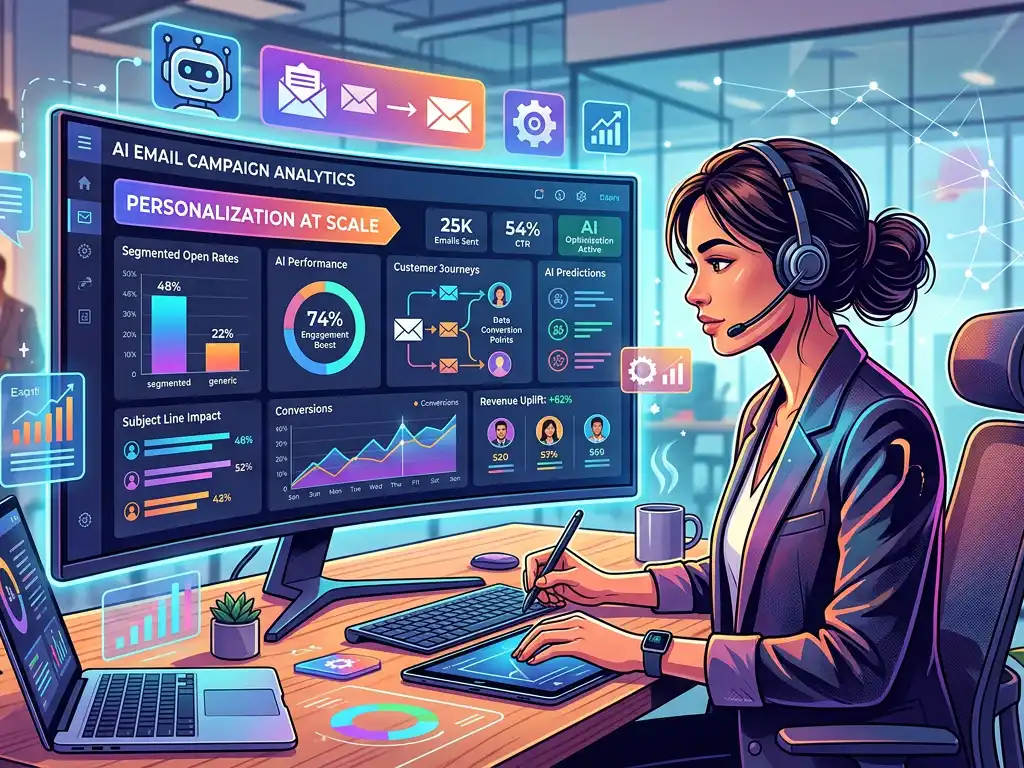
Email Marketing with AI: The Ultimate Guide to Personalization at Scale
Introduction: The Personalization Imperative in a Crowded Inbox
In today's digital landscape, the average office worker receives 121 emails per day. For marketers, breaking through this noise is the fundamental challenge. Generic, batch-and-blast email campaigns are no longer just ineffective—they’re a fast track to the spam folder and subscriber churn. The antidote? Personalization. But true one-to-one personalization for thousands, or millions, of subscribers has historically been a resource-intensive fantasy.
Enter Artificial Intelligence. AI is revolutionizing email marketing by making sophisticated, hyper-personalized communication not just possible, but scalable and efficient. It’s the difference between "Hello Customer" and "Hi [Name], based on your recent purchase of running shoes, here’s a guide to trails near [City]." This article will serve as your comprehensive guide to leveraging AI for email marketing, transforming your strategy from broad-strokes broadcasting to a dynamic, personalized conversation that drives unprecedented engagement and revenue.
How AI Transforms Email Marketing: Beyond the Basics
AI in email marketing moves far beyond simple merge tags for first names. It involves machine learning algorithms that analyze vast datasets to predict, personalize, and optimize in real-time.
Core AI Capabilities for Email Marketers:
- Predictive Analytics & Segmentation: AI algorithms analyze user behavior (opens, clicks, purchases, website browsing) to predict future actions. They can automatically segment audiences into micro-cohorts—like "high-intent cart abandoners" or "at-risk subscribers"—with incredible accuracy.
- Dynamic Content Generation: AI can create personalized subject lines, email body copy, product recommendations, and even images tailored to individual recipient preferences and past interactions.
- Send-Time Optimization: Instead of guessing the best time to send, AI determines the optimal send time for each subscriber based on when they are historically most likely to engage, boosting open rates.
- A/B Testing at Scale: AI can automate multivariate testing, running thousands of content, subject line, and layout combinations simultaneously to identify the top performers for different segments without manual setup.
- Behavioral Trigger Automation: Move beyond simple date-based triggers. AI enables complex behavioral triggers, such as sending a re-engagement offer when a subscriber's engagement score drops or a complementary product recommendation after they view a specific help article.
Essential AI-Powered Email Marketing Tools & Platforms
The market offers a spectrum of tools, from native AI features in established platforms to specialized AI-first solutions.
1. All-in-One Marketing Platforms with Integrated AI
These are comprehensive suites where AI is a built-in feature.
- HubSpot: Features AI-powered content creation tools for drafting emails, send time optimization, and predictive lead scoring to inform segmentation.
- Brevo (formerly Sendinblue): Offers Send Time Optimization and a Product Recommendations engine that uses AI to display personalized items.
- ActiveCampaign: Excels in predictive sending (optimal time for each contact) and predictive content, which suggests the best links and messages for individuals.
- Pricing: Typically operates on a tiered subscription model based on contacts/emails sent, with AI features often in mid-to-high tiers (e.g., $49-$299+/month).
2. Specialized AI-First Email & Personalization Tools
These tools focus deeply on AI-driven optimization.
- Phrasee: Specializes in AI-generated language optimization for subject lines, preheaders, and body copy that aligns with your brand voice. It uses natural language generation to create human-sounding, high-performing variants.
- Seventh Sense: Focuses on send-time intelligence. It integrates with HubSpot and Marketo to analyze individual engagement patterns and determine the perfect moment to send for each recipient, reducing list fatigue.
- Rasa.io: Unique AI-driven newsletter personalization. It curates a unique set of content (articles, offers) for each subscriber within a single newsletter broadcast based on their interests.
- Pricing: Often custom or high-tier pricing (e.g., $500+/month) due to the specialized, advanced nature of the AI.
3. AI Content Creation Assistants (For Ideation & Drafting)
Use these to supercharge your copywriting process.
- Jasper, Copy.ai, ChatGPT: Incredible for overcoming writer's block, generating multiple subject line variants, drafting email body copy frameworks, and brainstorming campaign ideas. They are supplements, not replacements, for human strategy and editing.
- Pricing: Range from freemium to subscription models ($20-$100+/month).
Real-World Use Cases & Practical Examples
Let’s translate theory into practice. Here’s how businesses are applying AI-driven email personalization.
Use Case 1: E-commerce & Retail
- Challenge: A sporting goods store wants to reduce cart abandonment and increase customer lifetime value.
- AI Solution: Implement an AI-powered platform like Klaviyo or Brevo.
- Practical Execution:
- Abandoned Cart Flow: An AI analyzes the abandoned items. For a user who left running shoes in their cart, the first email reminds them. The second, sent 24 hours later, dynamically includes AI-generated recommendations for running socks, shorts, or a hydration pack.
- Post-Purchase Nurture: After purchase, AI segments the buyer. A running shoe buyer automatically enters a "Runner" nurture sequence. Emails feature dynamically generated content like "Training Tips for Marathon Prep" or recommendations for replacement shoes based on the predicted product lifecycle.
- Result: Higher conversion rates on abandoned carts, increased average order value, and stronger brand loyalty through relevant follow-up.
Use Case 2: B2B SaaS
- Challenge: A SaaS company needs to improve demo sign-ups and reduce churn during free trials.
- AI Solution: Use a platform like ActiveCampaign or HubSpot with strong behavioral tracking.
- Practical Execution:
- Onboarding Emails: AI tracks which features a trial user engages with. If a user frequently uses the reporting dashboard but not the integration tool, their onboarding emails dynamically highlight advanced reporting tutorials and case studies, while gently introducing integration benefits.
- Predictive Lead Scoring: AI assigns a score based on website visits, email engagement, and demo attendance. Sales receives alerts for "hot leads" with high scores, enabling timely, personalized outreach.
- Result: More qualified demos, improved trial-to-paid conversion rates, and proactive churn prevention.
Use Case 3: Media & Content Publishers
- Challenge: A news website wants to increase click-through rates on its daily newsletter without creating dozens of versions.
- AI Solution: Implement a tool like Rasa.io or use advanced segmentation in Mailchimp.
- Practical Execution:
- Interest-Based Personalization: AI tags subscribers based on the topics of articles they click (e.g., "Technology," "Politics," "Finance").
- The "Unique Newsletter for One": Every subscriber gets the same newsletter template, but the three top story blocks are dynamically populated with the latest articles matching their interest tags. A tech enthusiast sees tech news first, while a finance reader sees market updates.
- Result: Dramatically higher engagement (CTR), reduced unsubscribe rates, and a perception of a highly relevant, curated service.
Actionable Tips & Best Practices for Implementation
Jumpstarting your AI email marketing journey requires strategy, not just technology.
1. Start with Data Hygiene
AI is only as good as the data it consumes. Audit your lists and CRM. Ensure you’re collecting meaningful behavioral data (page views, purchase history, engagement scores). Clean, structured data is the essential fuel for AI.
2. Begin with One High-Impact Use Case
Don't boil the ocean. Start with a single, manageable goal. Example: "Use AI send-time optimization to increase open rates for our weekly newsletter by 10% over the next quarter." This focused approach allows for clear measurement and learning.
3. Maintain a Human-in-the-Loop Approach
AI is a powerful assistant, not an autonomous marketer. Always review and edit AI-generated copy for brand voice and nuance. Use AI predictions (like lead scores) to inform human decisions, not replace them.
4. Prioritize Transparency and Privacy
Be clear with your subscribers about how you use their data for personalization. Ensure compliance with GDPR, CCPA, and other regulations. Trust is your most valuable asset; don't let AI erode it with creepy or non-compliant practices.
5. Test, Measure, and Iterate Relentlessly
Adopt a test-and-learn mindset. Even with AI optimizing sends, continually A/B test your core assumptions. Is a personalized subject line (using their company name) outperforming a benefit-driven one? Let the data guide your strategy evolution.
6. Focus on the "Why," Not Just the "What"
The most powerful personalization connects to intent. Instead of just recommending "products you may like," use AI to craft messaging that addresses the underlying need. "Struggling with social media scheduling? Our new AI assistant can cut your time in half" is more powerful than a generic feature announcement.
Conclusion & Key Takeaways
The era of impersonal mass emailing is over. AI has democratized deep personalization, making it a scalable, measurable, and essential component of modern marketing strategy. It’s not about replacing the marketer's creativity and strategic insight, but about augmenting it with superhuman data-processing capabilities.
Key Takeaways to Remember:
- AI Enables True 1:1 at Scale: It moves personalization beyond names and segments to dynamic content, predictive timing, and behavioral triggers for each individual.
- Start with Strategy, Not Tools: Define your goal (increase CLV, reduce churn, boost engagement) first, then select the AI capability (predictive sends, dynamic content, etc.) that serves it.
- The Tool Ecosystem is Maturing: Choose between AI features in all-in-one platforms (HubSpot, Brevo) for breadth or specialized AI tools (Phrasee, Seventh Sense) for depth in a specific area.
- Human Oversight is Non-Negotiable: AI generates options and predictions, but human marketers provide brand guardrails, emotional intelligence, and final strategic judgment.
- The Future is Adaptive: The next frontier is fully adaptive customer journeys, where AI doesn't just personalize a single email but dynamically maps the entire sequence of communications based on real-time behavior.
By embracing AI in your email marketing, you stop talking at your audience and start engaging with them in a meaningful, valuable dialogue. The result is not just improved metrics, but stronger customer relationships and sustainable business growth. Begin your AI integration today—start small, learn fast, and scale what works.