Free vs Paid AI Tools: Which Should You Choose?
Compare free and paid AI tools to determine which option is best for your needs and budget.
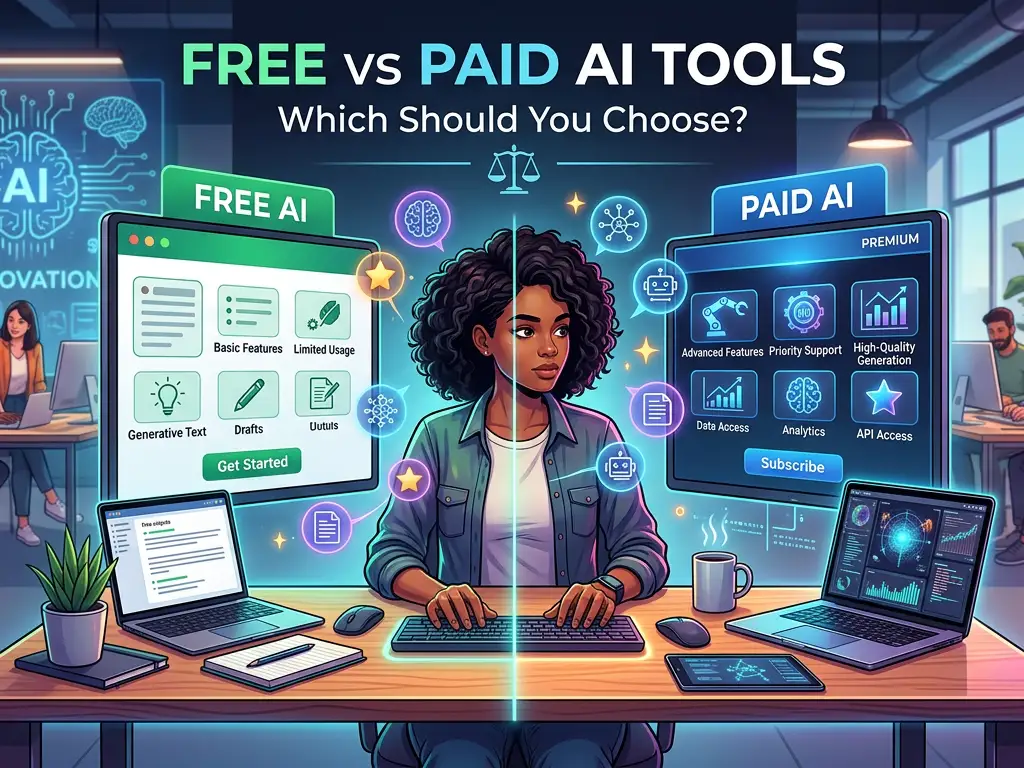
Free vs Paid AI Tools: The Ultimate Guide to Making the Right Choice
Introduction: Navigating the AI Tool Landscape
The artificial intelligence revolution is no longer on the horizon—it's here, transforming how we work, create, and solve problems. From generating marketing copy to analyzing complex datasets, AI tools are becoming indispensable across industries. But as you dive into this exciting ecosystem, you're immediately faced with a fundamental question: Should you use free AI tools or invest in paid solutions?
This decision isn't trivial. According to recent surveys, businesses that strategically implement AI tools report productivity increases of up to 40%, but those who choose poorly often face frustration, data security concerns, and wasted resources. Whether you're a solo entrepreneur, a creative professional, a student, or part of a corporate team, understanding the trade-offs between free and paid AI tools can mean the difference between leveraging AI as a competitive advantage and struggling with inadequate solutions.
In this comprehensive guide, we'll cut through the hype to provide a clear-eyed comparison of free versus paid AI tools. We'll explore specific use cases, break down what you're really getting (and giving up) with each option, and provide actionable frameworks to help you make the best choice for your specific needs and budget.
Understanding the AI Tool Ecosystem
Before comparing free and paid options, it's essential to understand the current landscape of AI tools available to users today.
Categories of AI Tools
AI tools generally fall into several functional categories:
- Generative AI: Tools like ChatGPT, Midjourney, and Claude that create text, images, code, or audio
- Analytical AI: Platforms that process and derive insights from data
- Automation AI: Tools that automate repetitive tasks and workflows
- Specialized AI: Domain-specific tools for marketing, coding, design, or research
The Spectrum of Pricing Models
AI tool pricing exists on a continuum:
- Completely Free (no payment required, often with limitations)
- Freemium (free tier with paid upgrades)
- Subscription-based (monthly/annual payments)
- Usage-based (pay per token/query/image)
- Enterprise (custom pricing for large organizations)
Most users will encounter the freemium model most frequently, which serves as a bridge between completely free and fully paid options.
The Case for Free AI Tools: More Than Just Cost Savings
Free AI tools have democratized access to artificial intelligence, putting powerful capabilities in the hands of millions who couldn't otherwise afford them.
Key Advantages of Free AI Tools
1. Zero Financial Barrier to Entry Free tools allow anyone to experiment with AI regardless of budget. This is particularly valuable for:
- Students and educators
- Bootstrapped startups and solopreneurs
- Individuals exploring AI for personal projects
- Organizations wanting to test AI before committing funds
2. Risk-Free Experimentation Without financial commitment, users can:
- Test multiple tools to find what works for their workflow
- Learn AI capabilities and limitations in a low-pressure environment
- Discover unexpected use cases through unstructured exploration
3. Surprisingly Capable Options Many free tools offer substantial functionality:
- ChatGPT's free version provides access to GPT-3.5 for most text tasks
- Google's Gemini offers robust capabilities without charge
- Canva's AI features include free design generation tools
- Hugging Face provides access to thousands of open-source models
Limitations of Free AI Tools
1. Usage Restrictions Most free tools implement limits such as:
- Daily or monthly query caps
- Slower processing speeds
- Queue positions during peak times
- Limited output length or complexity
2. Reduced Capability Free versions often lack:
- Access to the most advanced models (GPT-4 vs. GPT-3.5)
- Specialized features for complex tasks
- Customization and fine-tuning options
- Integration capabilities with other tools
3. Privacy and Data Concerns With free tools, you may encounter:
- Less transparent data usage policies
- Potential use of your inputs for model training
- Limited data protection guarantees
- Advertising or data monetization
4. Unpredictable Availability Free services may:
- Change terms or limitations without notice
- Experience more downtime
- Eventually discontinue free tiers
- Offer inconsistent performance
The Value Proposition of Paid AI Tools: When Investment Pays Off
Paid AI tools represent a significant evolution from their free counterparts, offering enhanced capabilities that can transform how individuals and organizations operate.
Key Advantages of Paid AI Tools
1. Enhanced Performance and Reliability Paid tools typically offer:
- Access to more advanced, capable models
- Faster processing and response times
- Higher reliability and uptime guarantees
- Priority support and troubleshooting
2. Advanced Features and Customization Subscription fees often unlock:
- Specialized tools for specific industries or tasks
- Custom model training and fine-tuning
- Advanced API access and integration options
- Team collaboration features and shared workspaces
3. Professional-Grade Output Paid tools excel at producing:
- Higher quality, more consistent results
- Outputs tailored to specific formats or requirements
- Brand-consistent content and designs
- Production-ready code, copy, or analysis
4. Enterprise-Ready Security and Compliance For business users, paid tools provide:
- Enhanced data privacy and security measures
- Compliance with regulations (GDPR, HIPAA, etc.)
- Service level agreements (SLAs)
- Dedicated account management
Common Pricing Structures
Individual Plans ($10-$50/month):
- Examples: ChatGPT Plus ($20/month), Midjourney ($10-$60/month)
- Best for: Professionals, serious creators, small business owners
Team/Business Plans ($20-$100+/user/month):
- Examples: GitHub Copilot Business, Jasper Teams
- Best for: Small to medium teams needing collaboration features
Enterprise Solutions (Custom pricing, often $1000+/month):
- Examples: Azure OpenAI Service, Salesforce Einstein
- Best for: Large organizations with specific security, compliance, and integration needs
Real-World Use Cases: Matching Tools to Needs
The "best" choice between free and paid AI tools depends entirely on your specific use case. Let's examine common scenarios.
Case Study 1: Content Creation for a Small Business
Scenario: A boutique marketing agency needs to produce 5 blog posts, 10 social media captions, and 2 email newsletters weekly.
Free Option Approach:
- Use ChatGPT's free version for ideation and outlines
- Leverage Canva's free AI for basic graphics
- Use Grammarly's free tier for editing
- Result: Manageable but time-consuming. Outputs require significant editing. Brand consistency is challenging.
Paid Option Approach:
- Subscribe to Jasper or Copy.ai ($49/month)
- Use Midjourney for custom graphics ($30/month)
- Implement Clearscope or MarketMuse for SEO optimization ($100+/month)
- Result: Higher quality output in less time. Better brand alignment. More comprehensive content strategy.
Verdict: For consistent, professional content production, paid tools typically justify their cost through time savings and quality improvements.
Case Study 2: Learning and Skill Development
Scenario: A university student wants to learn about AI capabilities while completing coursework.
Free Option Approach:
- Use free ChatGPT for research assistance and idea generation
- Experiment with Google's AI tools for various subjects
- Try different free coding assistants
- Result: Excellent for exploration and learning fundamentals without financial pressure.
Paid Option Approach:
- Subscribe to ChatGPT Plus for more reliable research assistance
- Use GitHub Copilot for coding projects ($10/month)
- Result: More reliable assistance during critical periods (exams, major projects), but may be unnecessary for casual learning.
Verdict: Free tools are typically sufficient for learning purposes, with paid options potentially valuable during intensive study periods.
Case Study 3: Software Development
Scenario: A freelance developer building applications for clients.
Free Option Approach:
- Use free versions of code completion tools
- Rely on Stack Overflow and community resources
- Result: Functional but slower development. More manual debugging required.
Paid Option Approach:
- GitHub Copilot ($10-$19/month)
- Tabnine Pro or similar ($12-$39/month)
- Result: Significantly faster coding. Fewer errors. Ability to take on more projects.
Verdict: For professional developers, paid coding assistants typically provide substantial ROI through increased productivity.
Case Study 4: Data Analysis for a Medium Business
Scenario: An e-commerce company needs to analyze customer data and generate insights.
Free Option Approach:
- Use Python with free libraries (Pandas, Scikit-learn)
- Implement open-source visualization tools
- Result: Possible but requires significant technical expertise. Time-consuming implementation.
Paid Option Approach:
- Use Tableau or Power BI with AI features ($70+/user/month)
- Implement specialized e-commerce AI tools
- Result: Faster insights. More accessible to non-technical team members. Actionable recommendations.
Verdict: For businesses without dedicated data science teams, paid tools democratize data analysis and provide faster time-to-insight.
Strategic Framework: How to Choose Between Free and Paid AI Tools
Making the right choice requires a systematic approach. Consider these factors:
1. Assess Your Core Needs
Ask yourself:
- What specific problems am I trying to solve?
- How frequently will I use AI tools?
- What quality level do I require?
- Is this for exploration or production use?
2. Calculate the True Cost
Consider:
- Direct costs: Subscription fees, usage charges
- Indirect costs: Time spent working around limitations, opportunity cost of inferior outputs
- Hidden costs: Training time, integration efforts, potential switching costs
3. Evaluate the Return on Investment
For paid tools, calculate potential ROI:
- Time saved per task × your hourly rate × frequency
- Quality improvements × value of better outcomes
- Competitive advantages gained
4. Consider Your Growth Trajectory
- Will your needs scale significantly in the next 6-12 months?
- Are you testing a concept before larger implementation?
- Do you need to demonstrate value before securing budget?
Practical Tips and Best Practices
Starting Strategy: The Smart Hybrid Approach
Begin with Free Tools
- Use free versions to understand your workflow needs
- Test multiple options before committing
- Identify which limitations actually impact your work
Implement a Pilot Program
- Select 1-2 paid tools for a focused trial (most offer free trials)
- Set specific metrics for evaluation
- Compare results against free alternatives
Adopt a Tiered Strategy
- Use free tools for exploratory or low-stakes work
- Implement paid tools for mission-critical or revenue-generating tasks
- Create clear guidelines for your team on when to use which tools
Maximizing Free Tools
- Combine multiple free tools to overcome individual limitations
- Learn prompt engineering to get better results from any AI
- Stay updated on new free offerings and temporary promotions
- Participate in beta programs to access premium features early
Justifying Paid Tools
- Track metrics before and after implementation
- Calculate time savings in hours, then convert to monetary value
- Document quality improvements and their business impact
- Start with individual subscriptions before team-wide deployment
Security and Privacy Considerations
Regardless of your choice:
- Never input sensitive data into AI tools without understanding their policies
- Review terms of service regarding data usage and ownership
- Implement data sanitization practices when possible
- Consider self-hosted options for highly sensitive applications
The Future of AI Tool Pricing
The landscape continues to evolve rapidly:
Increasing Capabilities in Free Tiers
- Competition is driving more features into free offerings
- Open-source models are catching up to proprietary ones
- Expect more generous free limits as infrastructure costs decrease
Specialization and Verticalization
- More industry-specific AI tools emerging
- Pricing models tailored to particular use cases
- Bundled AI features within existing software suites
New Pricing Models
- Credit-based systems becoming more common
- Outcome-based pricing for certain applications
- Hybrid models combining subscription and usage-based elements
Conclusion: Making Your Decision
The choice between free and paid AI tools isn't binary or permanent. The most effective approach is typically strategic and evolutionary.
Key Takeaways
Start with purpose, not price: Define what you need to accomplish before evaluating tools.
Free tools are legitimate solutions for many use cases, particularly exploration, learning, and low-volume applications.
Paid tools provide disproportionate value when used for professional, high-volume, or mission-critical work.
The hybrid approach often wins: Using free tools for some tasks and paid for others optimizes both cost and capability.
Regularly reassess: The AI tool landscape changes monthly. What made sense six months ago may not be optimal today.
Invest in learning: Regardless of which tools you choose, developing AI literacy and prompt engineering skills multiplies your results.
Final Recommendation Framework
If you're exploring, learning, or working on personal projects: Begin with free tools. You'll be surprised at what you can accomplish.
If you're a professional using AI occasionally: Stick with free tiers but consider paid options during intensive periods.
If you're using AI regularly for work or business: Invest in at least one paid tool that addresses your most critical need. The productivity gains will likely justify the cost.
If you're part of a team or organization: Develop a clear AI tool strategy that balances capability, cost, and security requirements.
The AI revolution offers unprecedented opportunities regardless of your budget. By making informed, strategic choices about which tools to use—and when to upgrade—you position yourself to harness artificial intelligence effectively, ethically, and economically. The most important step isn't choosing between free or paid; it's beginning your AI journey with intention and curiosity.
Remember: The best AI tool is the one that helps you achieve your goals without creating new problems. Start where you are, use what you have, and upgrade when the value becomes clear. Your perfect AI toolkit will evolve alongside your needs and the technology itself.