The Future of AI Tools: Trends to Watch in 2025
Discover the latest trends and innovations in AI tools that will shape the future of work and productivity.
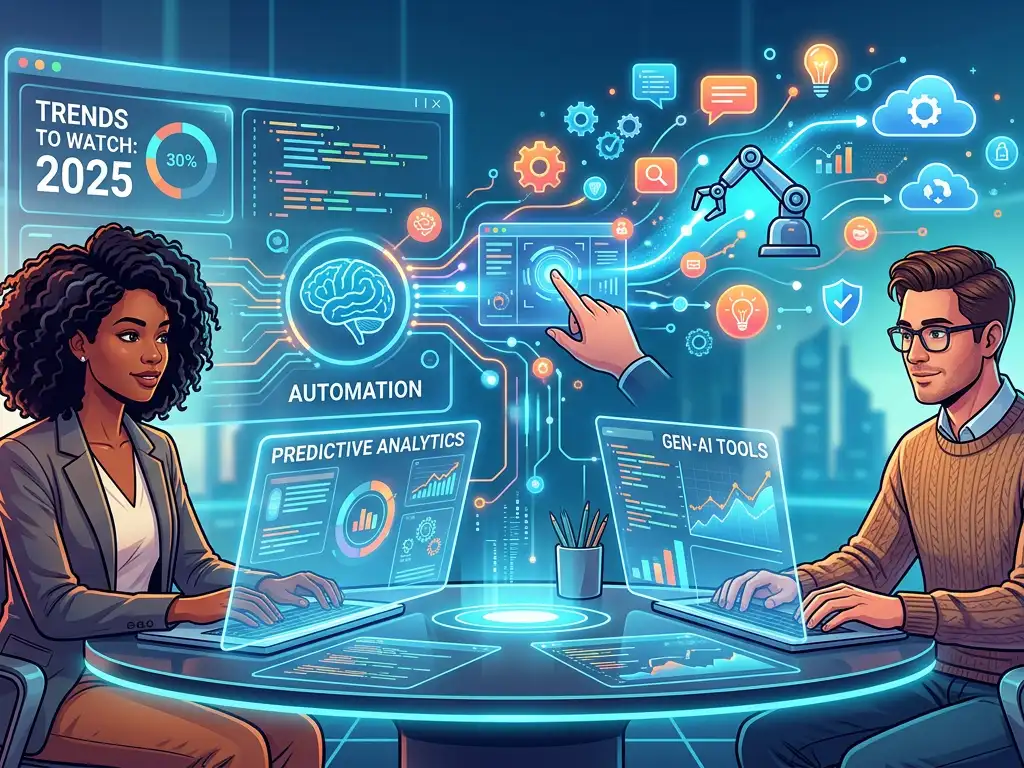
The Future of AI Tools: Trends to Watch in 2025
Introduction: The Accelerating AI Revolution
Artificial Intelligence has moved from a speculative concept to a core driver of productivity and innovation across every sector. As we look toward 2025, we stand at an inflection point where AI tools are transitioning from helpful assistants to indispensable collaborators. The global AI market, projected to exceed $1.8 trillion by 2030, is evolving at a breathtaking pace, with 2025 poised to deliver transformative changes that will redefine how we work, create, and solve complex problems.
Why does this matter to you? Whether you're a business leader, creative professional, developer, or simply someone looking to stay competitive, understanding these trends isn't about future-proofing—it's about present-positioning. The AI tools emerging today will become the standard operating environment of tomorrow. This comprehensive guide explores the most significant trends shaping AI tools in 2025, providing you with actionable insights, real-world applications, and strategic recommendations to harness these developments effectively.
The Rise of Autonomous AI Agents
From Assistants to Autonomous Operators
The most significant shift we'll witness in 2025 is the evolution of AI from reactive tools to proactive agents. Current AI largely responds to prompts and commands, but the next generation will operate with greater autonomy, capable of planning, executing multi-step tasks, and making context-aware decisions with minimal human intervention.
Key Characteristics:
- Goal-Oriented Execution: Instead of single-command responses, agents will pursue defined objectives (e.g., "Plan and execute a complete digital marketing campaign for Q1").
- Tool Integration Mastery: These agents will seamlessly navigate across software ecosystems, using APIs to connect disparate tools without manual bridging.
- Self-Correction and Learning: They'll analyze outcomes, identify failures in their approach, and adjust strategies autonomously.
Leading Tools and Platforms:
- AutoGPT & BabyAGI: Open-source frameworks that demonstrate early autonomous task execution capabilities.
- Microsoft's AutoGen: A framework for creating multi-agent conversations where different AI specialists collaborate.
- LangChain's Agent Ecosystem: Providing the building blocks for creating context-aware applications.
Pricing and Accessibility: While sophisticated enterprise agent systems will command premium subscriptions ($500-$5,000/month), open-source frameworks will democratize access for developers. Expect a bifurcated market with both high-end commercial platforms and accessible community-driven tools.
Practical Use Case: Imagine a content creation agent that doesn't just write a blog post when asked, but autonomously researches trending topics, analyzes competitor content, generates an optimized article, creates corresponding social media posts, schedules publication, monitors engagement metrics, and then iteratively improves future content based on performance data—all from a single initial goal statement.
Multimodal AI Becomes the Standard
The End of Single-Mode Limitations
2025 will see the full maturation of multimodal AI systems that seamlessly process and generate text, images, audio, video, and 3D models within a unified framework. This represents a fundamental shift from today's often siloed AI tools toward integrated systems that understand context across different media types simultaneously.
Key Developments:
- Cross-Modal Understanding: AI that can analyze a product manual (text), identify components in a video tutorial, and generate troubleshooting instructions based on both.
- Unified Generation Models: Single models capable of producing coordinated marketing materials including copy, graphics, and video scripts with consistent messaging.
- Enhanced Sensory Integration: Incorporation of non-traditional data types like sensor data, biometric information, and environmental inputs.
Leading Tools:
- GPT-5/Next-Gen Models: Expected to significantly advance multimodal capabilities beyond current limitations.
- Google's Gemini Pro: Already demonstrating sophisticated multimodal reasoning across text, images, and code.
- RunwayML Gen-3: Pushing boundaries in coordinated video, image, and text generation for creative workflows.
Pricing Models: Multimodal capabilities will increasingly become standard in premium AI subscriptions. Expect tiered pricing where basic plans offer text-only, while professional tiers ($100-$300/month) include full multimodal features. Enterprise solutions will offer custom training on proprietary data across modalities.
Real-World Example: An architectural firm could use multimodal AI to convert verbal client feedback ("I want the living room to feel brighter and more open") into multiple coordinated outputs: revised 3D models, material suggestions with sustainability ratings, adjusted lighting plans, and client presentation documents—all maintaining design consistency across different media.
Hyper-Personalization Through Adaptive AI
AI That Knows You Better Than You Know Yourself
In 2025, AI tools will move beyond basic user preferences to develop deep, adaptive understanding of individual workflows, cognitive styles, and unarticulated needs. This hyper-personalization will create tools that feel less like software and more like expert partners attuned to your specific way of working.
Key Features:
- Behavioral Adaptation: AI that learns your most productive times of day, preferred communication styles, and decision-making patterns.
- Context-Aware Assistance: Tools that understand not just what you're working on, but why, offering assistance aligned with your deeper objectives.
- Persona Matching: AI that can adapt its interaction style from "concise technical advisor" to "creative brainstorming partner" based on task and user preference.
Implementation Tools:
- Personal AI Models: Locally-run models trained on individual work patterns while maintaining privacy.
- Notion AI & Coda AI: Already demonstrating how project management tools can adapt to team workflows.
- Customizable ChatGPT-like Interfaces: Where users can define and refine their AI's personality and expertise areas.
Privacy Considerations: The most successful tools will implement sophisticated privacy-preserving techniques like federated learning (where the model learns from user data without that data leaving the device) and differential privacy (adding statistical noise to protect individual data points).
Practical Application: A financial analyst might work with an AI that learns their specific risk assessment methodology, automatically surfaces relevant precedents from past analyses, adapts its data visualization style to match what the analyst finds most intuitive, and even anticipates which stakeholders will have which questions about a report—preparing tailored explanations in advance.
Democratization of AI Development
No-Code/Low-Code AI for Everyone
The barrier to creating custom AI solutions will continue to plummet in 2025, with sophisticated no-code platforms enabling domain experts without programming backgrounds to build, train, and deploy AI tools specific to their needs. This democratization represents one of the most economically significant trends, potentially unleashing innovation at unprecedented scale.
Key Platforms:
- Bubble.io with AI Components: Enabling visual programming of AI-powered applications.
- Microsoft Power Platform AI Builder: Allowing businesses to create custom AI models for document processing, prediction, and object detection.
- Google's Vertex AI with AutoML: Simplifying custom model creation for specific business problems.
- Replit AI & GitHub Copilot X: Democratizing coding itself through AI assistance.
Cost Structure: Most platforms will follow a freemium model with free tiers for basic experimentation, professional tiers starting at $50-$150/month for serious development, and enterprise plans for deployment at scale. Training custom models will incur additional compute costs, but these are decreasing rapidly.
Transformative Use Case: A family-owned restaurant chain could use no-code AI tools to create a custom system that analyzes daily sales data, weather patterns, local event calendars, and social media sentiment to predict ingredient needs, optimize staffing schedules, and generate personalized marketing offers—all without hiring a data scientist or software developer.
AI Governance, Ethics, and Transparency Tools
The Rise of Responsible AI Infrastructure
As AI becomes more powerful and pervasive, 2025 will see accelerated development of tools designed to ensure ethical deployment, regulatory compliance, and operational transparency. This represents a maturation of the AI ecosystem, moving from "what can we build?" to "how should we build and deploy responsibly?"
Critical Tool Categories:
- Bias Detection and Mitigation: Tools like IBM's AI Fairness 360 and Google's What-If Tool will become integrated into development workflows.
- Explainability Platforms: Solutions that make complex AI decisions interpretable to humans, crucial for regulated industries.
- AI Governance Suites: Comprehensive platforms for managing model versions, monitoring for drift, ensuring compliance, and maintaining audit trails.
- Watermarking and Provenance: Tools for identifying AI-generated content, addressing growing concerns about misinformation and intellectual property.
Regulatory Drivers: With the EU AI Act coming into full force and similar regulations developing globally, compliance will become a primary concern for organizations deploying AI. Tools that simplify compliance will see rapid adoption.
Enterprise Implementation: Major cloud providers (AWS, Azure, Google Cloud) are building governance tools directly into their AI platforms. Expect to see comprehensive AI governance become a standard component of enterprise AI subscriptions, with specialized compliance tools adding 20-30% to platform costs but providing essential risk mitigation.
Practical Example: A healthcare provider using AI for diagnostic assistance would employ governance tools to continuously monitor for demographic bias in recommendations, maintain detailed audit trails of how AI suggestions influenced clinical decisions, provide explainable rationales for AI insights to medical staff, and ensure all models comply with HIPAA and emerging AI healthcare regulations.
Edge AI and Decentralized Processing
Intelligence at the Source
The limitations of cloud-dependent AI—latency, privacy concerns, bandwidth costs—are driving significant investment in edge AI for 2025. By processing data locally on devices, edge AI enables real-time responsiveness, enhanced privacy, and reduced operational costs for applications ranging from industrial IoT to personal devices.
Key Advancements:
- Specialized Edge Chips: Hardware from companies like NVIDIA (Jetson platform), Intel (Movidius), and Qualcomm (AI Engine) bringing unprecedented AI capability to edge devices.
- Federated Learning Frameworks: Allowing models to improve using data from multiple edge devices without that data ever leaving the devices.
- TinyML: Ultra-efficient machine learning models that can run on microcontrollers with minimal power consumption.
Cost Dynamics: While edge hardware requires upfront investment, it typically reduces ongoing cloud processing costs. For many applications, the total cost of ownership over 2-3 years favors edge deployment. Development frameworks are increasingly open-source, with commercial support available for enterprise implementations.
Industry Applications:
- Manufacturing: Real-time quality control on production lines with immediate feedback to robotic systems.
- Agriculture: Autonomous equipment making immediate decisions based on local conditions without waiting for cloud processing.
- Retail: Smart stores processing customer behavior data locally to protect privacy while optimizing layouts and inventory.
- Healthcare: Wearable devices providing immediate health insights without transmitting sensitive data to the cloud.
Implementation Example: An autonomous warehouse system using edge AI could have cameras on each robot identifying packages locally, making navigation decisions in real-time without network latency, coordinating with other robots through local mesh networking, and only sending aggregated efficiency data to the cloud for long-term optimization—all while keeping proprietary package handling data securely on-premises.
Practical Implementation Guide for 2025
Strategic Adoption Roadmap
Successfully leveraging 2025's AI trends requires more than just adopting new tools—it demands strategic integration into workflows and business processes. Here's a practical framework for implementation:
Phase 1: Assessment and Prioritization (Q1 2025)
- Conduct an AI maturity audit of your organization across departments
- Identify 2-3 high-impact, manageable use cases aligned with 2025 trends
- Calculate potential ROI considering both efficiency gains and new capability creation
- Example: A marketing agency might prioritize implementing multimodal AI for content creation and autonomous agents for campaign management.
Phase 2: Pilot Implementation (Q2 2025)
- Start with controlled pilots in low-risk, high-visibility areas
- Establish clear metrics for success beyond just cost savings (innovation rate, quality improvements, employee satisfaction)
- Implement governance frameworks from the beginning, even for pilots
- Tool Selection Criteria: Prioritize solutions with strong APIs for integration, transparent pricing models, and clear roadmaps aligned with 2025 trends
Phase 3: Scaling and Integration (Q3-Q4 2025)
- Develop internal expertise through dedicated AI champion roles
- Create integration protocols to connect AI tools with existing systems
- Establish continuous learning processes to keep pace with rapid AI evolution
- Budget Allocation: Based on current trends, allocate approximately 60% of AI budget to tools/platforms, 30% to training/change management, and 10% to experimentation with emerging capabilities
Actionable Recommendations for Different Roles
For Business Leaders:
- Start with strategy, not technology: Define what business outcomes you want AI to enable, then find tools that serve those goals.
- Create an AI ethics charter now, before implementation pressures mount.
- Invest in AI literacy across your organization, not just in technical teams.
- Example: A retail executive might focus on edge AI for in-store experience personalization while implementing no-code AI tools for inventory optimization.
For Developers and Technical Teams:
- Master API integration skills—the ability to connect AI tools will be more valuable than deep expertise in any single tool.
- Experiment with autonomous agent frameworks now to build experience ahead of widespread adoption.
- Prioritize learning about AI governance and MLOps—these skills will be in high demand.
- Tool Stack Recommendation: Begin with LangChain for agent development, Hugging Face for model experimentation, and Weights & Biases for model management.
For Creative Professionals:
- Develop "AI art direction" skills—the ability to guide AI tools with precise creative vision will differentiate professionals.
- Build multimodal portfolios that demonstrate proficiency across AI-enhanced text, visual, and audio creation.
- Master prompt engineering as a creative discipline—it's becoming as fundamental as composition or color theory.
- Practical Step: Dedicate 2-3 hours weekly to experimenting with emerging creative AI tools, documenting techniques that yield exceptional results in your specific domain.
For Small Business Owners:
- Leverage no-code AI platforms to solve specific business problems without technical staff.
- Implement AI tools that provide immediate ROI through time savings or customer experience improvements.
- Join AI-focused business communities to learn from peers implementing similar solutions.
- First Investment Suggestion: Start with an AI-enhanced CRM or customer service tool, as these typically offer the fastest and most measurable returns for small businesses.
Conclusion: Navigating the AI-Powered Future
As we approach 2025, the trajectory of AI tools is clear: they are becoming more autonomous, more integrated across modalities, more personalized, more accessible, more responsibly governed, and more distributed. The organizations and individuals who thrive will be those who approach these tools not as magic solutions, but as powerful capabilities to be understood, integrated, and directed toward meaningful objectives.
Key Takeaways for 2025:
- Autonomous AI agents will transition from novelty to necessity, requiring new workflows that leverage rather than resist their capabilities.
- Multimodal understanding will become the expected standard, breaking down barriers between different types of creative and analytical work.
- Hyper-personalization will create AI tools that feel like true collaborators, but will require thoughtful approaches to privacy and user agency.
- Democratization through no-code platforms will unleash innovation but also increase the need for AI literacy across all roles.
- Governance and ethics tools will evolve from optional to essential as regulatory and societal expectations mature.
- Edge AI deployment will expand AI's reach into real-time, privacy-sensitive, and bandwidth-constrained applications.
The most successful adopters will balance enthusiasm for AI's potential with thoughtful implementation, recognizing that the ultimate value lies not in the tools themselves, but in how they enhance human creativity, decision-making, and problem-solving. As you plan for 2025, focus less on chasing every new AI tool and more on developing the strategic framework, ethical guidelines, and organizational capabilities to leverage whatever tools emerge.
The future of AI tools isn't something that will happen to you—it's something you can shape through informed, intentional adoption starting today. The trends outlined here provide your roadmap; your unique expertise and needs will determine the destination.